De-Mystifying Recycling: Is It a Solution That Works?

Posted on Earthshare’s website on November 4, 2023

There is a lot of information—and a lot of misinformation—out there about recycling. It makes the entire process feel confusing and muddled. How does it work? And is it truly as effective as companies and plastic-producers make it out to be?  

The short answer: no. The effectiveness of recycling is quite limited (more on this later). Does this mean we should stop recycling? Absolutely not. What it does mean is that we need to find another solution to our trash problem. You may have heard the phrase, “we can’t recycle our way out of climate change,” and it’s true. Our waste problem far exceeds the quantity and quality of our recycling. The truth is that people—Americans specifically—have a “stuff” problem. We have too much of it. And we’re constantly being told by companies interested in increasing their bottom line that our stuff is disposable.  

Buy it, use it once, toss it, repeat.  

It’s an expensive way of life—not just for our pockets, but for the planet. Meanwhile, companies are making billions of dollars in profits. It’s time to stop the mass production AND mass consumption of products we just don’t need.

So, what do we do about it?  

Reduce. Reuse. Recycle. Refuse.

You were likely taught “Reduce, Reuse, Recycle” in school, but environmentalists have recently tacked on a fourth word to the end of the phrase, “Resist/Refuse.” In a similar vein to “Reduce,” it’s about limiting our purchases to the things we truly need; living as a conscience consumer and moving towards a zero waste society.This doesn’t mean we all need to live fully minimalist lifestyles. We’ll be perfectly transparent: a fully zero waste lifestyle is not achievable for most people or necessarily one you want to live, and that’s perfectly okay. It’s more important that we acknowledge our own consumerism and buying habits and be more conscious of our purchases; reducing the amount we buy to simply that which we need and refusing the rest.  

But what about the stuff that we do need to buy? How do we dispose of those things? That’s where reuse and recycle come into play. Reuse what you can, recycle what’s left. Recycling should always be the last step; the thing you do when all other options are eliminated.  

But now we’ve come full circle to the question of how recycling works. What can you recycle and where? Is recycling the same everywhere you go? Does it really work? And why aren’t all plastics recyclable?  

We’re tackling these questions and much more! Welcome to Recycling 101.  

Let’s get started. 

What Is Recycling?

It may seem like an obvious question with an obvious answer, but a survey from the World Economic Forum, SAP and Qualtrics showed that even though 75% of Americans support recycling, only 34% of them actually do it. Individuals reported that the confusion of the system prevents them from taking part. A second survey conducted by OnePoll shows that 64% of Americans self-reported that they did not know or understand their local recycling guidelines. That’s a lot of people!  

So, to make everything clearer, let’s start from scratch.  

Recycling is, simply, the process of turning waste into new materials or objects. Boom, simple.  

The more complicated question is what can be recycled? Not everything is recyclable. Food waste, for example, is compostable but not recyclable. To be recyclable, an item must be able to reobtain most, if not all, of the properties it had in its original state. (For example, aluminum, which is infinitely recyclable, can be melted down and then reformed into a new aluminum object without warping or growing weaker over time.) 

You’re probably familiar with the common recyclables—paper, aluminum, and glass—but you can also recycle:  

  • Cardboard  
  • Steel and other metals 
  • Batteries
  • Clothes
  • Electronics*
  • Wood

Both glass and metals are infinitely recyclable. Paper can be recycled roughly five times before it degrades too far and becomes waste.  

Have you noticed a big one missing from this list? What about plastics? Let’s take a closer look…  

*Typically requires specialized recycling and cannot be recycled curbside (via single stream recycling programs). Look for service providers in your area to find out where you can take these items for recycling. 

THE RECYCLABILITY OF PLASTICS

As much as petrochemical companies and other benefiting corporations would love to have you believe that recycling plastic is no big deal and it’s totally fine to buy just one more “disposable” water bottle, the truth is that plastics very much have a shelf life, not all plastics can be recycled, and those that can are NOT infinitely recyclable. Plastics that are recyclable can only be recycled once or twice before they degrade too much to be repurposed, becoming plastic waste. 

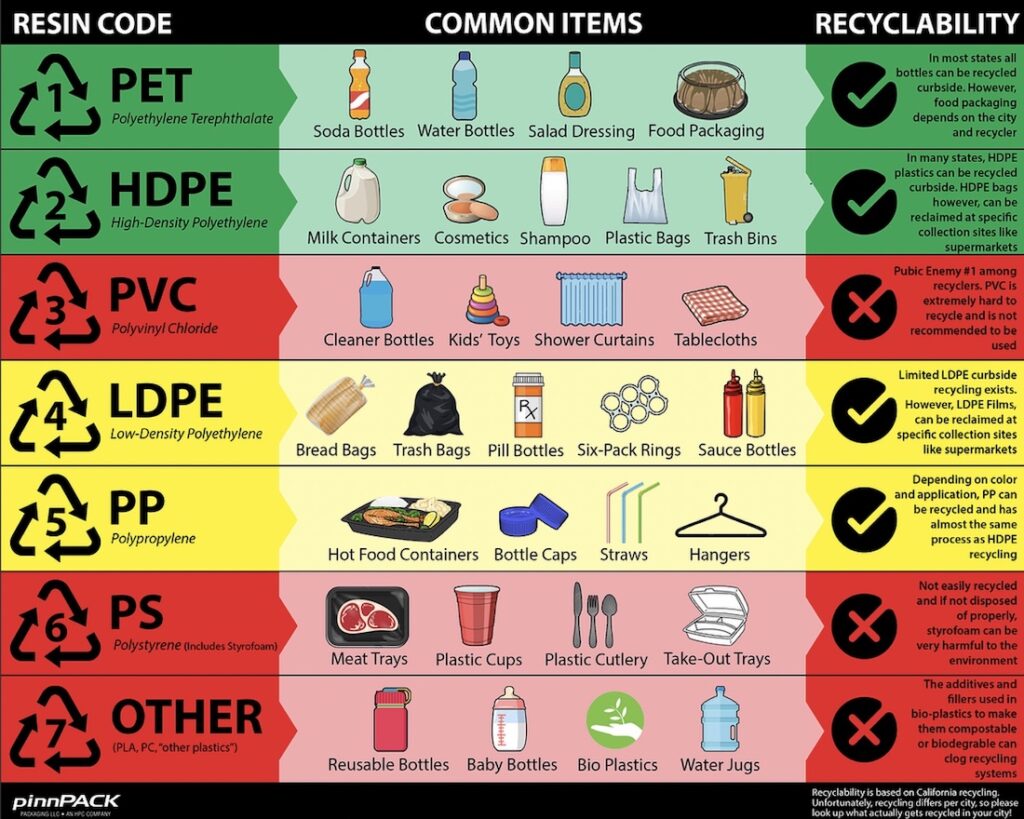
Have you noticed those symbols on plastic products; the ones with three arrows circling a number? Those are referred to as the “Chasing Arrows” and, despite popular belief, they DO NOT indicate whether or not a product is recyclable. They simply denote what kind of plastic the product is made from. Check out this quick guide from pinnPACK that breaks down these material types and their relative recyclability. 
plastic materials chart
Source: Sierra Club
Keep in mind that this graphic is specific to California and you always want to double check with your service provider about what is recyclable where you live! 

WHAT ABOUT MIXED MATERIALS?

A lot of what is on the shelves today are items made up of multiple materials; plastic and paper, glass and aluminum, metal and cardboard—the list goes on. So how are you supposed to recycle these items? Are they even recyclable at all?  

Unfortunately, the answer is both yes and no. If you can separate the materials from one another (for example, taking the aluminum lid off a glass mason jar), you are free to drop them—separately—into your single stream recycling bin and all is well with the world. However, if the materials are not easily separated, this can be a problem. Within the recycling stream in general, mixed material objects are some of the highest offenders when it comes to recycling contamination. Things like toothpaste tubes (frequently a combination of plastic and aluminum) and takeout coffee cups (plastic-lined paper) are often unable to be recycled.  

If you are unsure about whether or not a certain item is recyclable, check out this guide from Waste Management. And don’t forget to check with your recycling provider!

Why Recycle?

Because it saves a significant amount of natural energy and resources. In fact, the energy needed to produce recycled aluminum cans is 95% less than what is required to create them initially from scratch. For paper, this number is 60%. Recycling helps preserve the environment; protecting land, water, and resources from overuse and preventing more and more waste from entering landfills.  

At the end of the day, recycling is the responsible thing to do to protect the natural world, human health, and the future of…well…everyone. It’s pretty important.  

So then why is the U.S. so bad at recycling?  

Okay, okay, okay—so, technically the U.S. is neither the best nor the worst country at recycling. No country is great at recycling. What this does mean is that there’s definite room for improvement. According to a 2018 report from the EPA, the United States produced 267+ million tons of waste in 2017. Of this, only 94.2 million tons were recycled or composted.  

However, there’s a lot that can be done to address these things, starting with educating households and the U.S. population at large about what can and cannot be recycled. New innovations and the way recycled goods are utilized are also changing on a regular basis. So why aren’t we doing more of it?  

LIMITED ACCESS AND EXPENSE

When it comes to individuals, the answer usually boils down to a lack of convenient access to recycling. While recycling programs are becoming more and more common in urban areas, many rural communities still do not have the means or access to full-scale recycling services.  

For those communities that do have a recycling service, it can be an expensive and somewhat unreliable investment. For example, cities across the country are abandoning glass recycling, choosing to throw out any glass that ends up in their recycling stream despite the fact that glass is one of the most recyclable materials out there. And why? Cost. After China refused to continue importing recycled waste from countries around the world in 2018, the demand for recycled glass has become relatively unpredictable. For many small towns, the recycling process without a guaranteed buyer to purchase the recycled materials is a major expense; in some cases, even a money loser.  

Which is only compounded by the fact that recycling programs frequently compete for funding with other local institutions like schools and the police. Currently, there is no dedicated national investment in recycling—not to the level that we need right now—and since the U.S. does not have a federal recycling program, the burden of recycling is on the communities across the country that do have access. The way one city or county recycles might be different from another city or county in the same state, making state to state comparisons even more difficult.  

And then there’s the problem of single-stream recycling.  

While it’s true that this form of recycling lifts much of the burden from individuals and households, it leaves significantly more room for error when the recyclables reach the sorting facility. As a result, 25% of all U.S. recycling produced is considered contaminated and unusable.  

A staggering percentage that many scholars trace back to the American “illusion of recycling.”  

THE ILLUSION OF RECYCLING

Ed Humes, author of Garbology, says it best when he states, “…the waste producing public needs to fix the ‘illusion of recycling’—people’s ambitions to put trash, like plastic bags, in the recycling bin and feel good about it, out of sight and out of mind.” 

We’re told that recycling makes you a better person. It’s something we should all be doing to make the planet better. And yes, at the very least, this second statement is true! But uneducated recycling is just as bad as not recycling at all. We need to be conscious about what we’re putting in the bin, and we should be confident that it’s supposed to be there. “Wish-cycling” isn’t helpful; it only clogs up the gears of the process (literally), making it less efficient and more resource-demanding—the opposite of what recycling in general is trying to achieve.  

It is critical for all of us to make sure that we’re recycling properly. Now let’s talk about how.  

How the Recycling Process Works

What happens after the recyclables in your bin are collected or after you drop off your recycling at a community pickup location? We could write out a long, drawn-out answer for you, but then we thought… why would we do that when Hank Green explains it so much better on his SciShow YouTube Channel?  

Take a Look:  

 (All credit: Hank Green, SciShow on YouTube)  

So now you know the ins-and-outs of recycling. But what about how to recycle where you live? We’ve put together an assortment of resources to help you discover recycling service providers in your community, including specialized recycling providers for things like electronics and fabrics.  

Some regions also have local coalitions or associations focused on recycling/waste reduction

The Environmental Toll of Fracking: A Closer Look at Health, Culture, and Community

Posted on EarthShare’s website July 1, 2023

Fracking. The process of using a combination of water, chemicals, and sand to create cracks in rock formations deep underground in order to collect once-trapped gas and oil for use in the fossil fuel industry. Unlike traditional means of capturing fossil fuels, hydraulic fracturing (“fracking”) was touted as a “cleaner” alternative and, thus, has become a burgeoning industry over the past few decades. Fracking is not and NEVER was a transition energy.

The two states at the forefront of this industry? Texas and Pennsylvania. Combined, there are more than 629,000 fracked oil and gas wells in these two states—and this number only represents those wells that are reported. Because of the significant upfront investment and long timelines required for fracking, many companies go bankrupt, leading to a significant number of orphan wells. Unreported orphan wells are estimated to be in the tens of thousands, and without mandated clean-up standards or a national tracking system, abandoned oil and gas wells are a huge source of methane pollution across the country.

The U.S. is the second-leading exporter of fracked gas globally, and we unwisely continue to invest in this form of fossil fuel extraction, even as scientists and activists call for bans on new fossil fuel and petrochemical projects. And the consequences of these decisions are very, very human. They’re happening now. And they’re not good.

The History of Fracking in Pennsylvania 

Fracking happens all over the world, but to provide a more grounded view, let’s take a look at the state of Pennsylvania specifically. The practice of fracking became standard practice in the 1940s, but its history dates back even earlier in Pennsylvania when liquid nitroglycerin was used to “shoot” oil wells, stimulating rock formations to increase oil flow and extraction. Since the invention of hydraulic fracturing, more than one million wells have been drilled and fracked in the state. But what made this process so popular?

For starters, Pennsylvania is rich in shale (the deep, porous rock formations that house trapped gas and oil underground), and economically struggling communities were promised significant money to lease their land to fossil fuel companies for the extraction of fossil gases and oil. Unfortunately, this money was insubstantial compared to the construction, noise, contamination, and illness that faced these (often rural) communities.

Public safety policies are rarely enforced in pro-fossil fuel states, and communities suffer health complications from contaminated drinking water and breathing polluted air.

So, what are these risks?

A Quick Note

You might notice us using the term fossil gas throughout this blog instead of the more commonly used term “natural gas.” This is because natural gas isn’t natural at all. To make the concept of drilling for gas and oil more accessible and appealing to the general public, fossil fuel companies decided to call it “natural gas.” This gas, buried deep in the earth and created over millions of years, requires highly damaging drilling practices to retrieve, which puts human and environmental health at risk. So, while this gas may have formed naturally, it was never meant to reach the Earth’s surface in this manner. It’s a limited fossil resource, not a natural resource as we think about them today, and thus it is very much a man made, unnatural process. Referring to this gas as “natural” is one of the oldest forms of greenwashing.

The Health and Environmental Harms of Fracking 

An analysis by the Environmental Defense Fund shows that all elements of the oil and gas supply chain, including pipelines, compressor stations, and other fracking infrastructure, release methane into the atmosphere. Even conventional wells—those that are stimulated without the use of fracking or horizontal drilling—also contribute to methane release and leakage.

Fracking has also been connected to a greater number of earthquakes as the process of drilling and splitting rock destabilizes the structure of the land, causing erosion and making it less stable overall. The disposal of wastewater is also a factor in creating what is known as an “induced earthquake.” This not only poses risks to the land itself, but also displaces the wildlife that live in proximity, damaging existing—often critical—habitats.

Additionally, the practice of fracking requires a lot of water (fracking fluid consists of roughly 97% water), and the chemical cocktail is largely unknown. This often results in polluted water tables and the release of toxins, including carcinogens (cancer-causing chemicals) and other pollutants, which have been proven harmful to human health.

The state of Pennsylvania has the third highest cancer incidence rate in all of the United States. There are fifty-five known chemicals that fracked oil and gas operations release into the atmosphere, water, and soil—all known to cause cancer. 20 of these chemicals “have evidence of increased risk for leukemia or lymphoma specifically,” according to a study completed by the Yale School of Public Health. Oil and gas workers are consistently exposed to these toxic chemicals, one more commonly known one being benzene, as are those who live in close proximity to fracked well sites. Other health issues that have been linked to fracking include asthma and other lung conditions, low birth weights and birth defects, cardiovascular disease, and more.

Are the Benefits Worth It?

No, they’re not. Especially not when there are cheaper, cleaner, and more sustainable options available to us. Clean energy solutions, like solar and wind, are now cheaper than any other source of energy—gas, geothermal, coal, and nuclear included. And they come without any of the negative environmental and health repercussions created by the chemicals and processes of fracking (and fossil fuel retrieval in general). And while some may argue that fracked gas produces less carbon pollution than other fossil fuels when it burns (which is true), it is far from a “clean” energy source.

Solutions and Why You Should Care

The United States needs to transition to a clean energy economy, developing more renewable power and further improving energy efficiency. It’s a big lift, but energy usage is the same now as it was in 2000; something that’s been possible because of improvements in overall energy efficiency. These improvements have contributed more to the U.S.’ energy needs for the past 40 years than any known fossil fuel source; oil, coal fossil gas, or nuclear power. So, what does this mean for our future? It means we can power our economies with renewable power and further energy efficiency —we just have to make them a priority.

Other solutions that will help protect our communities and environment include:

  • Eliminating the creation of new oil and gas projects (including pipelines, compressor stationsfrack pads, oil and gas wells, or petrochemical hubs)
  • Establishing a ban on fracking (or, at the very minimum, establish protective buffer zones in states with unfavorable politics)
  • Reduce plastic at the source (e.g., petrochemical hubs) rather than promoting the myth that we can recycle our way out of the plastics pollution problem

Quite frankly, the arguments made in favor of fracking are largely from those benefiting financially from the process. Major corporations and wealthy individuals who back fracking are the only ones benefiting from it, and they’re certainly not the ones living with the health and environmental consequences.  

The truth? Fracking is— 

  • NOT cheaper than other clean energy sources
  • MORE harmful to human health than other clean energy sources
  • MORE destabilizing to the environment than other clean energy sources
  • Causing ACTIVE SUFFERING to the people living near fracking sites
  • DAMGING our environment; air, water, land, and wildlife

The time for compromises is long past; we need change now. And we’ll get there by electing officials who actively support clean energy legislation, supporting bans on fracking and other fossil fuel retrieving methods, educating ourselves on ongoing issues like fracking, and being loud about what we will and will not stand for in our communities.

It’s time for a change. Let’s make it happen together

We must fully fund America’s best conservation program

Bucks County Courier Times

Guest Opinion by Jessica Bellwoar

Posted Jul 2, 2019 at 11:34 AM    

As many of us get ready to kick off our July Fourth vacations, sightseeing and picnics, it’s the perfect time to celebrate America’s commitment to preserving the outdoors and our access to it.

But protecting and maintaining these iconic outdoor destinations don’t happen by accident. That requires sustained stewardship, as well as money. Right now, Congress has a chance to make sure Pennsylvania’s outdoor treasures are protected for generations to come.

That means fully funding America’s best conservation program: the Land and Water Conservation Fund.

In the early 1960s, President John F. Kennedy came up with the idea for the program, later signed into law by President Lyndon Johnson in 1965. The promise? To invest hundreds of millions of dollars in outdoor projects for the benefit of all Americans.

In the 54 years that the fund has been around, it has supported over 41,000 projects in all 50 states, whether national parks (think Valley Forge, the Appalachian Trail, Gettysburg and Delaware Water Gap), hiking trails or youth sports fields.

All Americans benefit from Land and Water Conservation dollars. Despite how long the fund has been around, most Pennsylvanians are unaware of how it enhances our quality of life and the environment around us. For example, the fund is the reason we could create the Flight 93 Memorial to both honor the victims from 9/11 and restore the surrounding area in Shanksville by planting hundreds of trees to build a new forest alongside the memorial.

Over the years, Congress has had to reauthorize the fund multiple times, but legislators have only twice fully funded the program at $900 million. Instead, common practice has been to divert the money elsewhere. In fact, Congress has raided $22 billion from the fund since its inception.

But in 2019, hope rises like spacious skies over amber waves of grain.

With overwhelming majorities, Congress passed a bill signed by President Donald Trump in March that permanently reauthorized the fund. Then, two weeks ago, a bipartisan group of representatives, including Rep. Brian Fitzpatrick from Bucks County, unveiled a bill in the House that would allocate the full annual allotment of $900 million. That bill has passed out of committee and now heads for a full floor vote. The Senate also held a hearing on June 25 on a similar bipartisan bill for full funding.

Fitzpatrick continues to be a vocal champion for Pennsylvania’s public parks and our outdoor treasures. If we are going to protect the Land and Water Conservation Fund for years to come, we need all of our Pennsylvania senators and members of Congress to fight for secure, permanent, long-term funding so that Bucks County can benefit from places like Neshaminy State Park, Tyler State Park and Core Creek Park.

So while we’re enjoying celebrating our nation’s birthday, we should remember that one of the reasons we have so many beautiful destinations to choose from is the Land and Water Conservation Fund. I think we can all agree that a dollar spent to protect America’s iconic landmarks today and for generations to come is a good investment.

I’m encouraged and inspired by the overwhelming public support behind the fund. Now it’s time for our elected officials to finish the job and fully fund America’s best conservation program.

Jessica Bellwoar is the conservation associate for PennEnvironment, a citizen-based nonprofit environmental advocacy group.

Photo Credit: Jackie Brochman

House approves public lands bill, permanently reauthorizing the Land and Water Conservation Fund

America’s most successful conservation and recreation program is now one step away from being law

PennEnvironment News Release

For Immediate Release

Tuesday, March 5, 2019

PHILADELPHIA — In a bipartisan 363-62 vote, the U.S. House of Representatives approved a public lands bill last week that, if signed into law by President Trump, will permanently reauthorize the Land and Water Conservation Fund (LWCF). The bill passed the Senate 92-8 in late February.

LWCF, a historically bipartisan program that has funded projects in all 50 states since its inception in 1965, expired on September 30, 2018. The program supported everything from the expansion and maintenance of local parks and recreation centers to places like the Delaware River Water Gap, Valley Forge, Gettysburg National Park, and the Flight 93 Memorial

In Pennsylvania, LWCF has helped fund the creation and maintenance of more than 1,500 projects investing more than $315 million in the Commonwealth.

While the vote passed with broad support, sadly, Congressman Scott Perry was the only Pennsylvania House delegate to oppose renewing the program. PennEnvironment applauds the members of Congress who voted in support of protecting public lands.

Jessica Bellwoar, Conservation Associate for PennEnvironment, issued the following statement.

“America’s public lands — our National Parks, Forests and Wildlife Refuges — are the nation’s best known treasures and at the heart of a legacy of what makes America beautiful. By permanently reauthorizing the Land and Water Conservation Fund, Congress has reinstated one of our best tools for ensuring we can protect these iconic places.”

“We urge President Trump to sign the bill into law. Our public lands deserve no less.”

####

PennEnvironment is a citizen-based, statewide environmental advocacy organization working to ensure clean air, clean water, and protecting Pennsylvania’s great natural heritage. For more information about this and other PennEnvironment projects, visit www.PennEnvironment.org.

For a list of projects funded by LWCF, go to https://www.lwcfcoalition.com/.  

U.S. Senate votes to renew Land and Water Conservation Fund

America’s most successful conservation program that protected Gettysburg, Valley Forge, and Flight 93 Memorial, has new life

PennEnvironment News Release

Wednesday, February 13, 2019

PHILADELPHIA, PA — The U.S. Senate passed a public lands package yesterday that permanently reauthorizes the Land and Water Conservation Fund (LWCF), a historically bipartisan program that has funded projects in every Pennsylvania county and in all 50 states since its inception in 1965. The program, which expired last September, has supported everything from the expansion and maintenance of local parks and recreation centers to national forests, national parks and historical sites.

In Pennsylvania, LWCF has helped fund the creation and maintenance of more than 1,500 projects investing more than $315 million in the Commonwealth.

“Pennsylvanians want our parks, forests and recreational places to stay beautiful and well-funded,” said Jessica Bellwoar, Conservation Associate for PennEnvironment. “Thankfully we’re seeing movement on reviving this program, and we applaud the U.S. Senate for getting the job done and not letting it fall through the cracks.”

Since LWCF funding expired, public lands projects have lost more than $300 million in revenue. While the Senate bill that passed yesterday permanently renews the program, it does not fully fund the program at the initial $900 million a year levels.

While the vote passed 92-8, sadly, Pennsylvania’s Senator Pat Toomey was one of the only senators to oppose renewing the program. PennEnvironment applauded U.S.  Senator Bob Casey for his longstanding support of LWCF and voting in favor of the proposal.

During the months leading up to and after the program expired, PennEnvironment collected over 5,000 petitions calling on Senators Casey and Toomey, and Pennsylvania’s congressional delegation to permanently reauthorize the program.

To build support for reauthorizing the Land and Water Conservation Fund, PennEnvironment also met with members of the state’s congressional delegation, garnered dozens of media stories on the importance of renewing LWCF, and ran billboards in targeted congressional districts calling on Pennsylvania’s congressional delegation to lead on LWCF.

“We need to protect our public lands for future generations, and the U.S. Senate took a big step toward doing so,” said Bellwoar. “Now it’s time for the U.S. House to act and permanently fund America’s beautiful parks and forests.

###

PennEnvironment is a citizen-based, statewide environmental advocacy organization working to ensure clean air, clean water, and protecting Pennsylvania’s great natural heritage. For more information about this and other PennEnvironment projects, visit www.PennEnvironment.org.

For a list of projects funded by LWCF, go to https://www.lwcfcoalition.com/.

After 52 years, program protecting Valley Forge, Gettysburg Park expires Sunday due to Congressional inaction

PennEnvironment Statement on Expiration of Land and Water Conservation Fund

For Immediate Release

Monday, October 1, 2018 

[Philadelphia, PA] — America’s most successful conservation and recreation program is expected to expire this Sunday, September 30. The Land and Water Conservation Fund (LWCF) has protected some of Pennsylvania’s most iconic places over the last 52 years.

“While it’s likely that few Pennsylvanians have heard of this program, every Pennsylvanian has enjoyed the places it’s protected,” stated Jessica Bellwoar, PennEnvironment’s Conservation Associate. “From Gettysburg to the Delaware Water Gap to Ohiopyle State Park, the Land and Water Conservation Fund has protected the places we love. Now we call on Congress to protect the Land and Water Conservation Fund.” The Land and Water Conservation Fund’s legacy has protected iconic places as well as local open spaces that often serve as the backbone to Pennsylvania’s communities (For a full list of LWCF projects funded in Pennsylvania, click here).  

LWCF has helped fund the creation and maintenance of more than 1,500 projects in Pennsylvania, investing more than $315 million in the Commonwealth since 1964. But the nation’s preeminent conservation program could now be left on the cutting room floor if Congress does not approve legislation to permanently reauthorize the Land and Water Conservation Fund. If the federally-funded program expires, much-needed conservation projects across the nation will suffer from lack of funding, protection, maintenance, and future acquisition of public land for recreational use.

“Environmental groups, outdoor enthusiasts, fishing and hunting organizations, and local officials are calling on Congress to move swiftly to resuscitate this program in the upcoming weeks before finishing the congressional session.” said Bellwoar. “”It doesn’t matter if you’re a Democrat or Republican–Pennsylvanians from all walks of life, all political affiliations, and every corner of the Commonwealth can all agree: we all enjoy the outdoor places that make the state and nation great, and we want our elected officials to make sure that we can continue to protect them for our kids and grandkids to enjoy.”

Even in an era of hyperpolarization in politics, LWCF has always historically received strong bipartisan support. While there is broad bipartisan support on the Hill, as often happens in Congress legislators wait until the last possible moment to accomplish things. For example, just 2 weeks ago the U.S. House of Representatives’ Committee on Natural Resources moved forward legislation to reauthorize LWCF.

Pennsylvania’s top elected officials have pleaded with federal leaders in Congress to renew this cornerstone conservation program.

“Congress must act to save this important community development and conservation tool for states and local communities,” Governor Tom Wolf stated. “Our economy depends on strong and attractive communities for businesses and workers to move, stay, and grow. Congress needs to permanently reauthorize the Land and Water Conservation Fund without delay.”

“Pennsylvania’s outdoor recreation industry supports 251,000 jobs, generates $86 billion in wages, contributes $1.9 billion in revenue and produces $30 billion in consumer spending,” U.S. Senator Bob Casey said. “These recreation areas, as well as national parks, historic sites and trails, are economic drivers and allow Pennsylvanians to protect and preserve pieces of the state’s unique landscape. It is essential that Congress provides consistent and sufficient funding for the LWCF to ensure that these sites and others throughout the country can continue to be enjoyed by generations to come.”

The Land and Water Conservation Fund has funded over 40,000 projects across the United States since 1964 and allocates more than $900 million dollars annually to states. The money is collected from gas and oil royalties and no taxpayer dollars are used.

PennEnvironment will continue to work with our U.S. House and Senate members to get the Land and Water Conservation Fund permanently reauthorized as soon as possible so our parks stay beautiful.

PAE_Jess_Bellwoar_LWCF_Staff_WEB
state park
Jessica Bellwoar collecting petitions in support of LWCF in Montgomery County in Neshaminy State Park (top). PennEnvironment Staff at Ohiopyle State Park, PA (bottom). 

#####

PennEnvironment is a citizen-based, statewide environmental advocacy organization working to ensure clean air, clean water, and protecting Pennsylvania’s great natural heritage. For more information about this and other PennEnvironment projects, visit www.PennEnvironment.org.

Help to preserve our places of natural heritage

Photo Credit: Valley Forge National Historical Park in Autumn (VFTCB)

Letter to the Editor of the Pittsburgh Post Gazette:

Published 09/01/18

Dear Editor,

Labor Day is a special weekend for families, and many Pennsylvanians will spend time outside visiting the state’s scenic landscapes and national parks.

What many Pennsylvanians may not realize is that many of these important natural heritages have been preserved through a program called the Land and Water Conservation Fund. They include places like Valley Forge, Gettysburg and the Flight 93 Memorial in Somerset County. Locally, it has helped fund more then $1.32 million in protection and maintenance of Settlers Cabin Regional Park, Brentwood Borough Community Park and North Shore Park.

Unfortunately, without congressional action this fall, LWCF will expire and put many of the greatest places here and across the country at risk. For decades, LWCF has protected the places we love and cherish. Now we must protect LWCF.

I hope concerned citizens will call and email Sens. Bob Casey and Pat Toomey and U.S. Rep. Conor Lamb and ask them to reauthorize LWCF this fall.

JESSICA BELLWOAR
Conservation Associate
PennEnvironment
Philadelphia, Pa.