It’s that time of year again when twinkling lights, soup, warm fires, and cozy sweaters become the norm for many, and—perhaps less obviously—people begin to think about their year-end giving. For most of us who have budgets to stick to throughout the year, it’s a time to assess where we stand and how much money we have to give to the causes and organizations we care about. And while, certainly, events occur throughout the year that inspire people to give, the importance of end-of-year giving cannot be understated.
For the majority of nonprofits, the month of December alone brings in a quarter of all annual donations—25% of the year’s donations in one month! That’s no small amount.
Giving by individuals is the largest source of philanthropy in the United States. Even more than billion-dollar foundations. It’s people—just like you—who are making the greatest difference. And why do people give? To have a positive impact on the world around them.
But are you making the most of your giving?
Earthshare encourages everyone to take action for a healthy planet! That’s why we spotlight our Network of 500+ environment, climate, and sustainability-focused Nonprofit Partners on our Platform, so you can learn more about the work being done to fight for healthy air, water, land, animals, and wildlife in your community.
But that’s not all. Want to donate to causes besides the environment? Support more than 1 million 501(c)(3) organizations across the U.S.!
All of the causes you love. No limitations. No restrictions.
How It Works
How do you get access to the EarthShare Giving Platform, and how does the Platform work?
For only $25 a year, you become an EarthShare Member and receive instant access to our Giving Platform. (Businesses can join, too, giving this same charitable giving platform to their employees. Learn more here.)
Once you create an account and log-in, you can immediately add funds to your DAF (via credit card or direct deposit, with the option to add recurring deposits) and start giving right away. Unlike other giving accounts, your EarthShare DAF has no minimum, meaning you can fund your account with as little as $.01 if you so choose.
From there, the giving world is your oyster!
Explore our extensive database of nonprofits. Find the organizations you love (including searching by your zip code to find nonprofits in your community).
Search by environmental issue areas. Discover nonprofits doing on-the-ground work for the causes that mean the most to you, from climate change to clean water and more.
Track your impact. See the good your giving is doing! Review your transactions as well as the nonprofits and issue areas you’ve supported. Plus, quickly download your giving receipts—all in one place (super convenient for taxes!).
Stay updated on environmental issues. Browse our extensive content library and learn more about the world’s most pressing environmental issues and the solutions taking place to address them. We have quizzes, tips for living a more sustainable lifestyle, and more.
This year-end giving season, don’t miss out on an opportunity to increase your impact. Whether you’re choosing to support EarthShare and our Network of vetted Nonprofit Partners, or you’re giving to other groups and organizations you love, do it all from one convenient place. No stress. No confusion.
There is a lot of information—and a lot of misinformation—out there about recycling. It makes the entire process feel confusing and muddled. How does it work? And is it truly as effective as companies and plastic-producers make it out to be?
The short answer: no. The effectiveness of recycling is quite limited (more on this later). Does this mean we should stop recycling? Absolutely not. What it does mean is that we need to find another solution to our trash problem. You may have heard the phrase, “we can’t recycle our way out of climate change,” and it’s true. Our waste problem far exceeds the quantity and quality of our recycling. The truth is that people—Americans specifically—have a “stuff” problem. We have too much of it. And we’re constantly being told by companies interested in increasing their bottom line that our stuff is disposable.
Buy it, use it once, toss it, repeat.
It’s an expensive way of life—not just for our pockets, but for the planet. Meanwhile, companies are making billions of dollars in profits. It’s time to stop the mass production AND mass consumption of products we just don’t need.
So, what do we do about it?
Reduce. Reuse. Recycle. Refuse.
You were likely taught “Reduce, Reuse, Recycle” in school, but environmentalists have recently tacked on a fourth word to the end of the phrase, “Resist/Refuse.” In a similar vein to “Reduce,” it’s about limiting our purchases to the things we truly need; living as a conscience consumer and moving towards a zero waste society.This doesn’t mean we all need to live fully minimalist lifestyles. We’ll be perfectly transparent: a fully zero waste lifestyle is not achievable for most people or necessarily one you want to live, and that’s perfectly okay. It’s more important that we acknowledge our own consumerism and buying habits and be more conscious of our purchases; reducing the amount we buy to simply that which we need and refusing the rest.
But what about the stuff that we do need to buy? How do we dispose of those things? That’s where reuse and recycle come into play. Reuse what you can, recycle what’s left. Recycling should always be the last step; the thing you do when all other options are eliminated.
But now we’ve come full circle to the question of how recycling works. What can you recycle and where? Is recycling the same everywhere you go? Does it really work? And why aren’t all plastics recyclable?
We’re tackling these questions and much more! Welcome to Recycling 101.
Let’s get started.
What Is Recycling?
It may seem like an obvious question with an obvious answer, but a survey from the World Economic Forum, SAP and Qualtrics showed that even though 75% of Americans support recycling, only 34% of them actually do it. Individuals reported that the confusion of the system prevents them from taking part. A second survey conducted by OnePoll shows that 64% of Americans self-reported that they did not know or understand their local recycling guidelines. That’s a lot of people!
So, to make everything clearer, let’s start from scratch.
Recycling is, simply, the process of turning waste into new materials or objects. Boom, simple.
The more complicated question is what can be recycled? Not everything is recyclable. Food waste, for example, is compostable but not recyclable. To be recyclable, an item must be able to reobtain most, if not all, of the properties it had in its original state. (For example, aluminum, which is infinitely recyclable, can be melted down and then reformed into a new aluminum object without warping or growing weaker over time.)
You’re probably familiar with the common recyclables—paper, aluminum, and glass—but you can also recycle:
Cardboard
Steel and other metals
Batteries*
Clothes*
Electronics*
Wood*
Both glass and metals are infinitely recyclable. Paper can be recycled roughly five times before it degrades too far and becomes waste.
Have you noticed a big one missing from this list? What about plastics? Let’s take a closer look…
*Typically requires specialized recycling and cannot be recycled curbside (via single stream recycling programs). Look for service providers in your area to find out where you can take these items for recycling.
THE RECYCLABILITY OF PLASTICS
As much as petrochemical companies and other benefiting corporations would love to have you believe that recycling plastic is no big deal and it’s totally fine to buy just one more “disposable” water bottle, the truth is that plastics very much have a shelf life, not all plastics can be recycled, and those that can are NOT infinitely recyclable. Plastics that are recyclable can only be recycled once or twice before they degrade too much to be repurposed, becoming plastic waste.
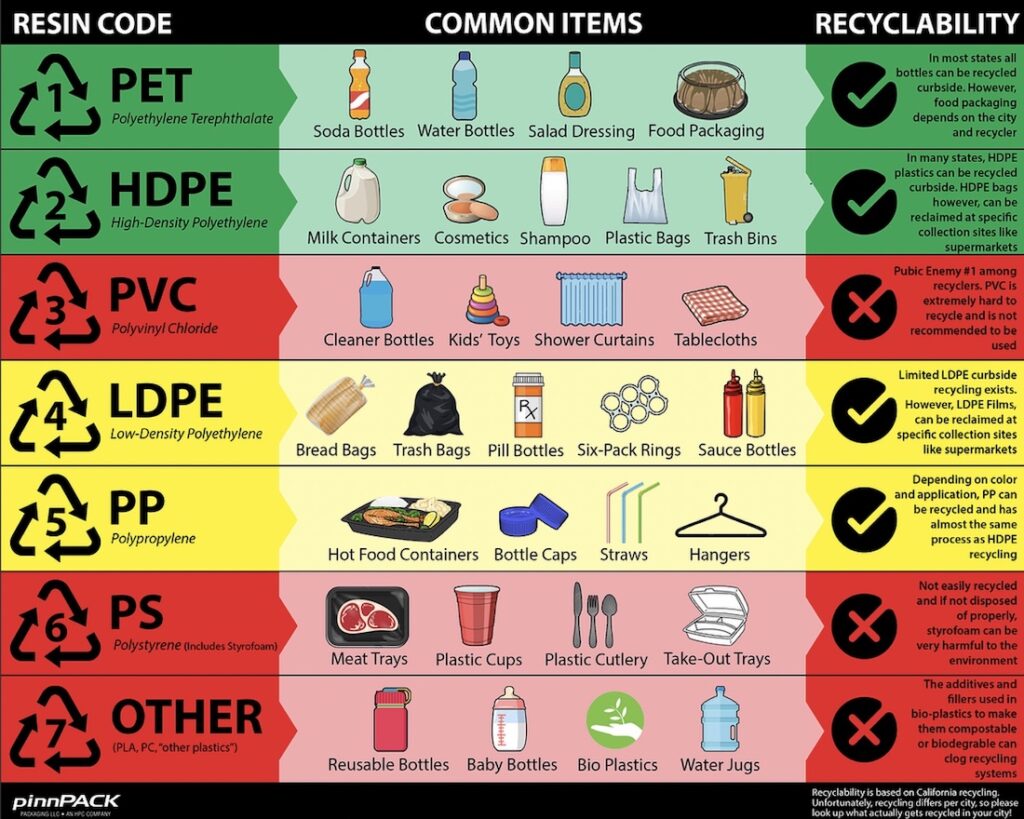
Have you noticed those symbols on plastic products; the ones with three arrows circling a number? Those are referred to as the “Chasing Arrows” and, despite popular belief, they DO NOTindicate whether or not a product is recyclable. They simply denote what kind of plastic the product is made from. Check out this quick guide from pinnPACK that breaks down these material types and their relative recyclability.
Source: Sierra Club
Keep in mind that this graphic is specific to California and you always want to double check with your service provider about what is recyclable where you live!
WHAT ABOUT MIXED MATERIALS?
A lot of what is on the shelves today are items made up of multiple materials; plastic and paper, glass and aluminum, metal and cardboard—the list goes on. So how are you supposed to recycle these items? Are they even recyclable at all?
Unfortunately, the answer is both yes and no. If you can separate the materials from one another (for example, taking the aluminum lid off a glass mason jar), you are free to drop them—separately—into your single stream recycling bin and all is well with the world. However, if the materials are not easily separated, this can be a problem. Within the recycling stream in general, mixed material objects are some of the highest offenders when it comes to recycling contamination. Things like toothpaste tubes (frequently a combination of plastic and aluminum) and takeout coffee cups (plastic-lined paper) are often unable to be recycled.
If you are unsure about whether or not a certain item is recyclable, check out this guide from Waste Management. And don’t forget to check with your recycling provider!
Why Recycle?
Because it saves a significant amount of natural energy and resources. In fact, the energy needed to produce recycled aluminum cans is 95% less than what is required to create them initially from scratch. For paper, this number is 60%. Recycling helps preserve the environment; protecting land, water, and resources from overuse and preventing more and more waste from entering landfills.
At the end of the day, recycling is the responsible thing to do to protect the natural world, human health, and the future of…well…everyone. It’s pretty important.
So then why is the U.S. so bad at recycling?
Okay, okay, okay—so, technically the U.S. is neither the best nor the worst country at recycling. No country is great at recycling. What this does mean is that there’s definite room for improvement. According to a 2018 report from the EPA, the United States produced 267+ million tons of waste in 2017. Of this, only 94.2 million tons were recycled or composted.
However, there’s a lot that can be done to address these things, starting with educating households and the U.S. population at large about what can and cannot be recycled. New innovations and the way recycled goods are utilized are also changing on a regular basis. So why aren’t we doing more of it?
LIMITED ACCESS AND EXPENSE
When it comes to individuals, the answer usually boils down to a lack of convenient access to recycling. While recycling programs are becoming more and more common in urban areas, many rural communities still do not have the means or access to full-scale recycling services.
For those communities that do have a recycling service, it can be an expensive and somewhat unreliable investment. For example, cities across the country are abandoning glass recycling, choosing to throw out any glass that ends up in their recycling stream despite the fact that glass is one of the most recyclable materials out there. And why? Cost. After China refused to continue importing recycled waste from countries around the world in 2018, the demand for recycled glass has become relatively unpredictable. For many small towns, the recycling process without a guaranteed buyer to purchase the recycled materials is a major expense; in some cases, even a money loser.
Which is only compounded by the fact that recycling programs frequently compete for funding with other local institutions like schools and the police. Currently, there is no dedicated national investment in recycling—not to the level that we need right now—and since the U.S. does not have a federal recycling program, the burden of recycling is on the communities across the country that do have access. The way one city or county recycles might be different from another city or county in the same state, making state to state comparisons even more difficult.
While it’s true that this form of recycling lifts much of the burden from individuals and households, it leaves significantly more room for error when the recyclables reach the sorting facility. As a result, 25% of all U.S. recycling produced is considered contaminated and unusable.
A staggering percentage that many scholars trace back to the American “illusion of recycling.”
THE ILLUSION OF RECYCLING
Ed Humes, author of Garbology, says it best when he states, “…the waste producing public needs to fix the ‘illusion of recycling’—people’s ambitions to put trash, like plastic bags, in the recycling bin and feel good about it, out of sight and out of mind.”
We’re told that recycling makes you a better person. It’s something we should all be doing to make the planet better. And yes, at the very least, this second statement is true! But uneducated recycling is just as bad as not recycling at all. We need to be conscious about what we’re putting in the bin, and we should be confident that it’s supposed to be there. “Wish-cycling” isn’t helpful; it only clogs up the gears of the process (literally), making it less efficient and more resource-demanding—the opposite of what recycling in general is trying to achieve.
It is critical for all of us to make sure that we’re recycling properly. Now let’s talk about how.
How the Recycling Process Works
What happens after the recyclables in your bin are collected or after you drop off your recycling at a community pickup location? We could write out a long, drawn-out answer for you, but then we thought… why would we do that when Hank Green explains it so much better on his SciShow YouTube Channel?
Take a Look:
(All credit: Hank Green, SciShow on YouTube)
So now you know the ins-and-outs of recycling. But what about how to recycle where you live? We’ve put together an assortment of resources to help you discover recycling service providers in your community, including specialized recycling providers for things like electronics and fabrics.
If you’ve ever wondered how you can sustain your legacy of good—even after you’re gone—writing a nonprofit into your will is a great way to continue to give back through your estate. But what about other forms of giving, such as living trusts and bequest giving? Let’s start by talking through all the definitions you’re going to need to know.
Terms to Know
While a will and living trust are both estate planning tools, the main difference between them is how they are managed:
A will, a legal document detailing your assets (money, physical belongings, etc.) and how they should be managed after you pass, is implemented after death.
A living trust on the other hand places all of your assets into a trust fund that can be distributed to your heirs and beneficiaries while you are still alive.
Other terms that you’ll want to be familiar with include:
Legacy Giving – Contributions donors plan to give to a nonprofit after they die.
Estate Planning – The process of creating a legal plan for what should happen to your estate (a term used to refer to all your assets combined) after your death.
Bequest Giving – Similar to Legacy Giving, this is the donation (or “gifting”) of a large amount of money; often (but not always) after the donor has passed away.
What Can You Donate to a Nonprofit In Your Will?
Money in the form of cash may seem like an obvious answer to this question, but did you know you can also donate stocks and bonds as well as add a nonprofit as a beneficiary to your life insurance and retirement funds? That’s right, your estate represents your total assets—not just the money you currently have in your savings account—so this is also money you have to donate if you so choose.
You’re also able to donate real estate, such as your house or another piece of property, as well as personal property such as your vehicle, jewelry, and artwork. You can even include directions in your will for how you would like the nonprofit to use these assets. For example, do you want your vehicle to be gifted to a family in need of the nonprofit’s choosing, or do you want the nonprofit to sell your assets for cash? You have the flexibility to choose what and how you want to contribute; it’s your legacy, after all.
Details You Need to Know
In order to write a nonprofit into your will, there are some official details you will need to have in hand. First and foremost, the full legal name, address, and EIN number of the nonprofit you are interested in donating to. You’ll also want to know exactly how you intend to donate to them. In other words, what is the nature of your gift (cash, property, stock investments, etc.), and how much do you plan to give? Make sure you’re very specific about the number of properties, amount of cash, and/or the percentage of your estate you want to contribute.
From there, you’ll need to decide what kind of beneficiary you want the nonprofit to be: primary, secondary, residuary, or contingency. Most commonly, nonprofits are listed as residuary beneficiaries, meaning they receive a gift only after the primary beneficiaries have received their share of the estate. However, this is not the only method available. You might also want to choose:
Primary Beneficiary –the nonprofit receives all the assets you assign them.
Secondary Beneficiary—if your primary beneficiary passes away before you do, the nonprofit receives all assets intended for the primary beneficiary.
Contingency Gift – the nonprofit is listed as a “backup plan” in case your beneficiaries pass away before you do. This form of giving can also be used as a contingency plan if certain stipulations you put in your will aren’t met. For example, you may say that, in order to receive your estate, your beneficiary must be sober, stay out of jail, etc. If these conditions are not met, your estate is then donated to the nonprofit you’ve chosen.
If you have any questions or concerns about these details, make sure you speak with a qualified estate attorney or your financial advisor!
How Do Gifts From Your Estate Benefit EarthShare?
Estate gifts are kind of a big deal! In general, estate gifts tend to be larger in value and size than one-time cash donations, which means that when you give a legacy gift to EarthShare, you are able to make a BIG and positive impact on the environment.
Your gift also helps us plan for the future. Being able to know what donations will be coming to the organization now and in the future helps us identify more substantial timelines and goals for projects and initiatives, enabling us to do more good. Your contribution directly supports our mission of building a healthier, more sustainable planet for everyone, and enables positive work and change in your memory. That’s a legacy to be proud of.
Ready to Get Started? Here Are Your Next Steps
Contact our Development Director, Jessica Bellwoar, at jessica@earthshare.org to let her know your plans
Speak to a financial advisor or estate attorney to make sure you’ve fully addressed all relevant details
If you include EarthShare in your plans, please use the following legal name and tax identification number:
Legal Name: EarthShare
Address: 1717 K Street NW, Suite 900, Washington, DC 20006.
Federal Tax Number/EIN: 52-1601960
Please note that we at EarthShare are not lawyers and are not qualified to give you official legal advice. If you need additional support when it comes to charitable giving and estate planning, be sure to speak with a qualified legal professional!
Pennsylvania taxpayers spend over $13 million every year just cleaning up roadside litter. This money should be spent on more important things such as public education.
Plastics are slowly killing life on earth. We enjoy the convenience of plastics but delude ourselves that we can dispose of them safely. We give little thought to the damage done to the environment and to public health that results from extracting the fossil fuel needed to produce and manufacture plastics. We worry about climate change but stubbornly do not make the connection between plastic production and emissions of greenhouse gases. Most people falsely believe that recycling plastics is the answer — even though the vast majority of plastics can not be recycled and there is no real market for recycled plastics. Most of us will remember that distressing video of a sea-turtle with a plastic straw stuck in its nose. That’s happening every day. Plastics don’t really break down, they turn into dangerous microplastics that we’re now consuming.
Plastics are everywhere — some are necessary, many are not. Food wrappers, cigarette filters, single-use plastic bags, plastic straws, styrofoam.
The easiest plastics to avoid are the single-use plastic items we use for convenience or out of habit. As residents, we pay a high financial cost for single-use plastics. The City of Philadelphia spends between $9 million and $12 million every year cleaning plastic bags from the streets, sewers, and bodies of water. Philadelphia alone uses approximately one billion plastic bags per year, many of which end up as litter in our neighborhoods. Pennsylvania taxpayers spend over $13 million every year just cleaning up roadside litter. This money should be spent on more important things such as public education.
The plastic and petrochemical industry mislead the public by marketing plastics as “recyclable” when in reality, less than 9% of all plastic ever produced has been recycled. There is no viable solution for plastic waste. According to the United Nations Environment Programme, 12% of plastics are burned in incinerators (increasing air pollution in communities of color where waste incinerators are typically located) and 79% of plastics are deposited in landfills, dumps or end up in the natural environment.
Nearly all plastics produced derive from oil, fracked gas, and coal — dirty, non-renewable resources. Plastics and the climate crisis go hand-in-hand: plastic production depends on fossil fuels, and fossil fuels rely on plastic production.
Another hidden cost to single-use plastics: human health. For instance, Royal Dutch Shell’s 386-acre ethane cracker—built to make plastics— is set to power up this year about 25 miles outside of Pittsburgh in Beaver County. Shell’s plant will release 159 tons per year of fine particulate matter and 522 tons per year of volatile organic compounds (VOC), according to the Council’s 2014 Health Impacts Assessment. VOCs exacerbate health conditions including asthma, cardiovascular disease, cancer, endocrine disruption, and adverse birth outcomes.
The Council spent more than 10 years advocating to pass a Philadelphia single-use plastic bag ban. However, Philadelphia’s plastic bag ban was delayed one year due to COVID-19 and will now go into effect on July 1, 2021.
The Council advocates for turning off the “plastics tap,” and is fighting legislation that would limit local government’s ability to regulate single-use plastic items. Representing Pennsylvania residents in court, the Council joined the City of Philadelphia, Borough of West Chester, Borough of Narberth, Lower Merion Township, and the City of Pittsburgh in a lawsuit to overturn the state’s unconstitutional preemption of municipalities from enacting or enforcing single-use plastic legislation. The Council is fighting for local residents and leaders to implement sustainable solutions locally to plastic pollution.
It’s time to end our addiction to plastic, enact local solutions, and choose to protect the environment over convenience. Start by ditching single-use plastics for Plastic Free July and spreading the word about plastic pollution.
Written by Jessica Bellwoar, Development Officer, jbellwoar@cleanair.org. For more information on the PA Plastics Preemption lawsuit contact, Logan Welde, Staff Attorney, lwelde@cleanair.org.
As many of us get ready to kick off our July Fourth vacations, sightseeing and picnics, it’s the perfect time to celebrate America’s commitment to preserving the outdoors and our access to it.
But protecting and maintaining these iconic outdoor destinations don’t happen by accident. That requires sustained stewardship, as well as money. Right now, Congress has a chance to make sure Pennsylvania’s outdoor treasures are protected for generations to come.
That means fully funding America’s best conservation program: the Land and Water Conservation Fund.
In the early 1960s, President John F. Kennedy came up with the idea for the program, later signed into law by President Lyndon Johnson in 1965. The promise? To invest hundreds of millions of dollars in outdoor projects for the benefit of all Americans.
In the 54 years that the fund has been around, it has supported over 41,000 projects in all 50 states, whether national parks (think Valley Forge, the Appalachian Trail, Gettysburg and Delaware Water Gap), hiking trails or youth sports fields.
All Americans benefit from Land and Water Conservation dollars. Despite how long the fund has been around, most Pennsylvanians are unaware of how it enhances our quality of life and the environment around us. For example, the fund is the reason we could create the Flight 93 Memorial to both honor the victims from 9/11 and restore the surrounding area in Shanksville by planting hundreds of trees to build a new forest alongside the memorial.
Over the years, Congress has had to reauthorize the fund multiple times, but legislators have only twice fully funded the program at $900 million. Instead, common practice has been to divert the money elsewhere. In fact, Congress has raided $22 billion from the fund since its inception.
But in 2019, hope rises like spacious skies over amber waves of grain.
With overwhelming majorities, Congress passed a bill signed by President Donald Trump in March that permanently reauthorized the fund. Then, two weeks ago, a bipartisan group of representatives, including Rep. Brian Fitzpatrick from Bucks County, unveiled a bill in the House that would allocate the full annual allotment of $900 million. That bill has passed out of committee and now heads for a full floor vote. The Senate also held a hearing on June 25 on a similar bipartisan bill for full funding.
Fitzpatrick continues to be a vocal champion for Pennsylvania’s public parks and our outdoor treasures. If we are going to protect the Land and Water Conservation Fund for years to come, we need all of our Pennsylvania senators and members of Congress to fight for secure, permanent, long-term funding so that Bucks County can benefit from places like Neshaminy State Park, Tyler State Park and Core Creek Park.
So while we’re enjoying celebrating our nation’s birthday, we should remember that one of the reasons we have so many beautiful destinations to choose from is the Land and Water Conservation Fund. I think we can all agree that a dollar spent to protect America’s iconic landmarks today and for generations to come is a good investment.
I’m encouraged and inspired by the overwhelming public support behind the fund. Now it’s time for our elected officials to finish the job and fully fund America’s best conservation program.
Jessica Bellwoar is the conservation associate for PennEnvironment, a citizen-based nonprofit environmental advocacy group.
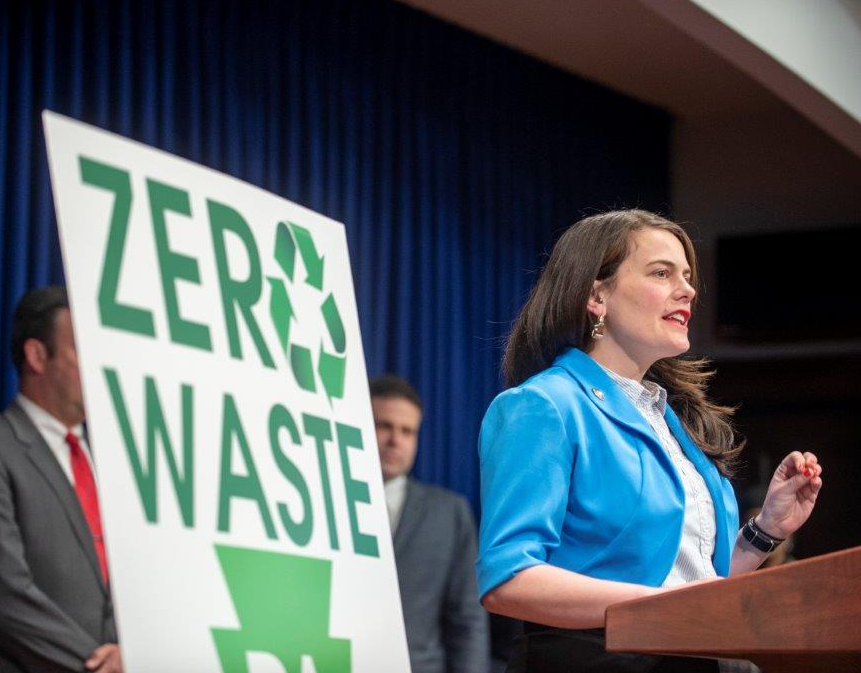
MARPLE, PA — PennEnvironment and Representative Mike Zabel of Delaware County joined Newtown, Haverford, and Marple Townships for their Annual Electronic Recycling Event on Saturday.
Thousands of residents took advantage of the townships free recycling event. Yet, many in Pennsylvania don’t have access to electronic recycling programs. It’s one reason PennEnvironment is working with Rep. Zabel and others State House legislators on the “Zero Waste PA” legislative package to address our state’s growing waste and to tackle our “throw-away” society.
Saturday’s recycling drive-through event took place at Delaware County Community College and drew township residents, whose cars zig-zagged in long rows around the parking lots as they waited to unload their old cell phones, computers, televisions, microwaves, fax machines, air conditioners, small appliances, and more. Township officials estimate that more than 4,000 residents took part in the electronic waste, or e-waste, recycling event this year. Residents waited in lines for up to 2 hours to make sure they were diligently recycling their obsolete and unused electronic products.
“Residents across Delaware County and across Pennsylvania want the ability to easily recycle their outdated electronics because it’s good for the environment,” said Jessica Bellwoar, PennEnvironment’s Conservation Associate, “but we have vastly inadequate e-waste recycling programs and facilities in Pennsylvania and challenged by a failing e-waste program”.
In 2017, there were 58.1 million pounds of covered devices recycled in PA by 62 manufacturers according to the Pennsylvania DEP. Despite this seemingly large amount, we only recycle 12.5 percent of e-waste nationally.
“It’s clear that Delco residents want a better way to recycle their our old electronics, and I am committed to making that process easier and more accessible,” said Rep. Mike Zabel. “This isn’t a partisan issue, just one of a common sense. Our electronics recycling law needs reform, and I am ready to lead the way.”
While e-waste represents only 2% of America’s trash in landfills, it represents 70% of the toxicity in the waste stream as electronics contain dangerous chemicals like mercury, cadmium, and lead. Research has shown that leached toxic materials in electronics can cause cancer, reproductive disorders, brain and kidney damage and many other health problems.
To better protect our environment from toxic run-off and properly dispose of our electronics, we need to dramatically update Pennsylvania’s e-waste programs to be more effective.
That’s why PennEnvironment is thankful to Rep. Mike Zabel for introducing legislation in the State House to modernize Pennsylvania’s e-waste law and make it easier for all of us to recycle our old or unused electronics.
“When over two-thirds of Pennsylvania counties do not have access to free and convenient electronic recycling,” said Bellwoar, “we need to act and make it easier for all Pennsylvanians to be good stewards of the earth by recycling their electronic products.”
Rep. Zabel’s legislation is part of the “Zero Waste PA” package of 13 house bills aiming to reduce how disposable our society has become.
###
PennEnvironment is a statewide, citizen-based grassroots environmental advocacy group, dedicated to protecting our air, water and open spaces. We investigate problems, craft solutions, educate the public and decision-makers, and help the public make their voices heard in local, state and national debates over the quality of our environment and our lives. For more information, visit www.PennEnvironment.org.
As the nation celebrates Earth Day this week, it’s important to applaud the leadership of our local elected officials working to protect our environment.
In particular, I was excited to hear about Chester County Reps. Danielle Friel Otten and Melissa Shusterman introducing legislation to create composting systems and improve systems for “hard to recycle” items like plastic and styrofoam packaging.
The representatives proposals are part of a larger package of bills being introduced in the Pennsylvania General Assembly called the “Zero Waste PA” legislation.
In total, the Zero Waste Pa. legislation will promote more recycling across the state, address pollution from single use plastics and chronic litter problems facing many communities, and help divert waste from our landfills and incinerators.
This Earth Day, Reps. Friel Otten and Shusterman deserve a pat on the back from their constituents for their work to make sure that every day is Earth Day.
PHILADELPHIA — In a bipartisan 363-62 vote, the U.S. House of Representatives approved a public lands bill last week that, if signed into law by President Trump, will permanently reauthorize the Land and Water Conservation Fund (LWCF). The bill passed the Senate 92-8 in late February.
LWCF, a historically bipartisan program that has funded projects in all 50 states since its inception in 1965, expired on September 30, 2018. The program supported everything from the expansion and maintenance of local parks and recreation centers to places like the Delaware River Water Gap, Valley Forge, Gettysburg National Park, and the Flight 93 Memorial
In Pennsylvania, LWCF has helped fund the creation and maintenance of more than 1,500 projects investing more than $315 million in the Commonwealth.
While the vote passed with broad support, sadly, Congressman Scott Perry was the only Pennsylvania House delegate to oppose renewing the program. PennEnvironment applauds the members of Congress who voted in support of protecting public lands.
Jessica Bellwoar, Conservation Associate for PennEnvironment, issued the following statement.
“America’s public lands — our National Parks, Forests and Wildlife Refuges — are the nation’s best known treasures and at the heart of a legacy of what makes America beautiful. By permanently reauthorizing the Land and Water Conservation Fund, Congress has reinstated one of our best tools for ensuring we can protect these iconic places.”
“We urge President Trump to sign the bill into law. Our public lands deserve no less.”
####
PennEnvironment is a citizen-based, statewide environmental advocacy organization working to ensure clean air, clean water, and protecting Pennsylvania’s great natural heritage. For more information about this and other PennEnvironment projects, visit www.PennEnvironment.org.
PHILADELPHIA, PA — The U.S. Senate passed a public lands package yesterday that permanently reauthorizes the Land and Water Conservation Fund (LWCF), a historically bipartisan program that has funded projects in every Pennsylvania county and in all 50 states since its inception in 1965. The program, which expired last September, has supported everything from the expansion and maintenance of local parks and recreation centers to national forests, national parks and historical sites.
In Pennsylvania, LWCF has helped fund the creation and maintenance of more than 1,500 projects investing more than $315 million in the Commonwealth.
“Pennsylvanians want our parks, forests and recreational places to stay beautiful and well-funded,” said Jessica Bellwoar, Conservation Associate for PennEnvironment. “Thankfully we’re seeing movement on reviving this program, and we applaud the U.S. Senate for getting the job done and not letting it fall through the cracks.”
Since LWCF funding expired, public lands projects have lost more than $300 million in revenue. While the Senate bill that passed yesterday permanently renews the program, it does not fully fund the program at the initial $900 million a year levels.
While the vote passed 92-8, sadly, Pennsylvania’s Senator Pat Toomey was one of the only senators to oppose renewing the program. PennEnvironment applauded U.S. Senator Bob Casey for his longstanding support of LWCF and voting in favor of the proposal.
During the months leading up to and after the program expired, PennEnvironment collected over 5,000 petitions calling on Senators Casey and Toomey, and Pennsylvania’s congressional delegation to permanently reauthorize the program.
To build support for reauthorizing the Land and Water Conservation Fund, PennEnvironment also met with members of the state’s congressional delegation, garnered dozens of media stories on the importance of renewing LWCF, and ran billboards in targeted congressional districts calling on Pennsylvania’s congressional delegation to lead on LWCF.
“We need to protect our public lands for future generations, and the U.S. Senate took a big step toward doing so,” said Bellwoar. “Now it’s time for the U.S. House to act and permanently fund America’s beautiful parks and forests.
###
PennEnvironment is a citizen-based, statewide environmental advocacy organization working to ensure clean air, clean water, and protecting Pennsylvania’s great natural heritage. For more information about this and other PennEnvironment projects, visit www.PennEnvironment.org.
With the holiday shopping season upon us, it’s easy to get caught up in the excitement and buy more than we need, for our children and for others. Here are ten tips for how you can help reduce plastic pollution and other waste around the holidays:
1. Give the gift of sustainability. Don’t have an idea for what to get your loved ones for the holidays? How about a plastic-free starter kit? Durable travel mugs and water bottles, reusable grocery bags and food containers, silicone sandwich bags, and glass, steel, or bamboo straws are all great alternatives to their single-use plastic counterparts and can go a long way towards reducing a loved one’s plastic footprint.
2. Skip the plastic packaging where you can. When buying gifts, you can reduce your plastic footprint by avoiding gifts that are heavily packaged in plastic, especially children’s toys. Most of the time, this packaging can’t be recycled, so it will inevitably end up in the landfill or our natural environment.
3. Buy local. Shopping locally can help avoid all of the excess packaging and shipping materials from shopping online. Buying in person rather than online can also reduce the fossil fuels needed to transport your goods across the country– plus, you’ll be supporting a local business in your community at the same time!
4. Consider buying used or refurbished electronics. In the market for new electronics this holiday season? Consider buying them refurbished instead of new. Repaired devices can provide equivalent performance at much lower prices and help mitigate the environmental impacts of brand new devices. Just make sure to recycle your old electronic products and don’t throw them in the trash. Check out this online guide from our friends at PennPIRG to learn what to look for and what to avoid when buying used or refurbished electronics.
5. Consider buying other gifts used as well. Though it might seem less glamorous, there are a lot of things out there in perfect condition looking for a new home, and they can be found for lower prices while reducing waste. Swing by your local thrift shop, consignment shop, or antique store and see if you can find some hidden treasures.
6. Skip giving “things.” Who says that your holiday gifts have to be “things” at all? Giving memberships and subscriptions as presents can provide year-long benefits while avoiding the production costs of ever-more stuff. Or, go even more low-tech and hand out coupons for a date night or a home cooked meal. Not only is this less wasteful, the thought and creativity of this gift will be well-received.
7. Cook and bake at home. Cooking at home as opposed to ordering takeout or buying pre-prepared food can help save takeout packaging and is a fun thing to do over the holidays. After your meal, if you have a lot of food left over, consider donating it to a local food rescue organization or food pantry, avoiding food waste.
8. Save your gift wrapping. When wrapping– and unwrapping– your gifts, keep in mind that gift bags and wrapping paper can be saved and used again in future years.
9. Repair a loved one’s favorite possession. Another great gift option that actively helps reduce waste while ensuring the person getting the gift will love it is deceptively simple: repair what your loved ones already have. We all have a favorite jacket with a busted zipper or a pair of shoes in desperate need of a resole; instead of getting new items, helping to fix what’s already beloved is a no-brainer.
10. Give a loved one a membership to PennEnvironmet. Please consider giving your friends and family (or yourself #selflove) the gift of membership to PennEnvironment. We are working hard to reduce plastic pollution and fight waste every day: http://bit.ly/PAEHolidayGift
Wishing you a happy and sustainable holiday season!









 JESSICA BELLWOAR