
U.S. Senate votes to renew Land and Water Conservation Fund

America’s most successful conservation program that protected Gettysburg, Valley Forge, and Flight 93 Memorial, has new life

PennEnvironment News Release

Wednesday, February 13, 2019

PHILADELPHIA, PA — The U.S. Senate passed a public lands package yesterday that permanently reauthorizes the Land and Water Conservation Fund (LWCF), a historically bipartisan program that has funded projects in every Pennsylvania county and in all 50 states since its inception in 1965. The program, which expired last September, has supported everything from the expansion and maintenance of local parks and recreation centers to national forests, national parks and historical sites.

In Pennsylvania, LWCF has helped fund the creation and maintenance of more than 1,500 projects investing more than $315 million in the Commonwealth.

“Pennsylvanians want our parks, forests and recreational places to stay beautiful and well-funded,” said Jessica Bellwoar, Conservation Associate for PennEnvironment. “Thankfully we’re seeing movement on reviving this program, and we applaud the U.S. Senate for getting the job done and not letting it fall through the cracks.”

Since LWCF funding expired, public lands projects have lost more than $300 million in revenue. While the Senate bill that passed yesterday permanently renews the program, it does not fully fund the program at the initial $900 million a year levels.

While the vote passed 92-8, sadly, Pennsylvania’s Senator Pat Toomey was one of the only senators to oppose renewing the program. PennEnvironment applauded U.S.  Senator Bob Casey for his longstanding support of LWCF and voting in favor of the proposal.

During the months leading up to and after the program expired, PennEnvironment collected over 5,000 petitions calling on Senators Casey and Toomey, and Pennsylvania’s congressional delegation to permanently reauthorize the program.

To build support for reauthorizing the Land and Water Conservation Fund, PennEnvironment also met with members of the state’s congressional delegation, garnered dozens of media stories on the importance of renewing LWCF, and ran billboards in targeted congressional districts calling on Pennsylvania’s congressional delegation to lead on LWCF.

“We need to protect our public lands for future generations, and the U.S. Senate took a big step toward doing so,” said Bellwoar. “Now it’s time for the U.S. House to act and permanently fund America’s beautiful parks and forests.

###

PennEnvironment is a citizen-based, statewide environmental advocacy organization working to ensure clean air, clean water, and protecting Pennsylvania’s great natural heritage. For more information about this and other PennEnvironment projects, visit www.PennEnvironment.org.

For a list of projects funded by LWCF, go to https://www.lwcfcoalition.com/.

Ten tips for reducing holiday waste

Published on PennEnvironment website, Dec 2018

Co-authors: Jessica Bellwoar, Celeste Meiffren-Swango

With the holiday shopping season upon us, it’s easy to get caught up in the excitement and buy more than we need, for our children and for others. Here are ten tips for how you can help reduce plastic pollution and other waste around the holidays:

1. Give the gift of sustainability. Don’t have an idea for what to get your loved ones for the holidays? How about a plastic-free starter kit? Durable travel mugs and water bottles, reusable grocery bags and food containers, silicone sandwich bags, and glass, steel, or bamboo straws are all great alternatives to their single-use plastic counterparts and can go a long way towards reducing a loved one’s plastic footprint.

2. Skip the plastic packaging where you can. When buying gifts, you can reduce your plastic footprint by avoiding gifts that are heavily packaged in plastic, especially children’s toys. Most of the time, this packaging can’t be recycled, so it will inevitably end up in the landfill or our natural environment.

3. Buy local. Shopping locally can help avoid all of the excess packaging and shipping materials from shopping online. Buying in person rather than online can also reduce the fossil fuels needed to transport your goods across the country– plus, you’ll be supporting a local business in your community at the same time!

4. Consider buying used or refurbished electronics. In the market for new electronics this holiday season? Consider buying them refurbished instead of new. Repaired devices can provide equivalent performance at much lower prices and help mitigate the environmental impacts of brand new devices. Just make sure to recycle your old electronic products and don’t throw them in the trash. Check out this online guide from our friends at PennPIRG to learn what to look for and what to avoid when buying used or refurbished electronics.

5. Consider buying other gifts used as well. Though it might seem less glamorous, there are a lot of things out there in perfect condition looking for a new home, and they can be found for lower prices while reducing waste. Swing by your local thrift shop, consignment shop, or antique store and see if you can find some hidden treasures.

6. Skip giving “things.” Who says that your holiday gifts have to be “things” at all? Giving memberships and subscriptions as presents can provide year-long benefits while avoiding the production costs of ever-more stuff. Or, go even more low-tech and hand out coupons for a date night or a home cooked meal. Not only is this less wasteful, the thought and creativity of this gift will be well-received.

7. Cook and bake at home. Cooking at home as opposed to ordering takeout or buying pre-prepared food can help save takeout packaging and is a fun thing to do over the holidays. After your meal, if you have a lot of food left over, consider donating it to a local food rescue organization or food pantry, avoiding food waste.

8. Save your gift wrapping. When wrapping– and unwrapping– your gifts, keep in mind that gift bags and wrapping paper can be saved and used again in future years.

9. Repair a loved one’s favorite possession. Another great gift option that actively helps reduce waste while ensuring the person getting the gift will love it is deceptively simple: repair what your loved ones already have. We all have a favorite jacket with a busted zipper or a pair of shoes in desperate need of a resole; instead of getting new items, helping to fix what’s already beloved is a no-brainer.

10. Give a loved one a membership to PennEnvironmet. Please consider giving your friends and family (or yourself #selflove) the gift of membership to PennEnvironment. We are working hard to reduce plastic pollution and fight waste every day: http://bit.ly/PAEHolidayGift 

Wishing you a happy and sustainable holiday season!

After 52 years, program protecting Valley Forge, Gettysburg Park expires Sunday due to Congressional inaction

PennEnvironment Statement on Expiration of Land and Water Conservation Fund

For Immediate Release

Monday, October 1, 2018 

[Philadelphia, PA] — America’s most successful conservation and recreation program is expected to expire this Sunday, September 30. The Land and Water Conservation Fund (LWCF) has protected some of Pennsylvania’s most iconic places over the last 52 years.

“While it’s likely that few Pennsylvanians have heard of this program, every Pennsylvanian has enjoyed the places it’s protected,” stated Jessica Bellwoar, PennEnvironment’s Conservation Associate. “From Gettysburg to the Delaware Water Gap to Ohiopyle State Park, the Land and Water Conservation Fund has protected the places we love. Now we call on Congress to protect the Land and Water Conservation Fund.” The Land and Water Conservation Fund’s legacy has protected iconic places as well as local open spaces that often serve as the backbone to Pennsylvania’s communities (For a full list of LWCF projects funded in Pennsylvania, click here).  

LWCF has helped fund the creation and maintenance of more than 1,500 projects in Pennsylvania, investing more than $315 million in the Commonwealth since 1964. But the nation’s preeminent conservation program could now be left on the cutting room floor if Congress does not approve legislation to permanently reauthorize the Land and Water Conservation Fund. If the federally-funded program expires, much-needed conservation projects across the nation will suffer from lack of funding, protection, maintenance, and future acquisition of public land for recreational use.

“Environmental groups, outdoor enthusiasts, fishing and hunting organizations, and local officials are calling on Congress to move swiftly to resuscitate this program in the upcoming weeks before finishing the congressional session.” said Bellwoar. “”It doesn’t matter if you’re a Democrat or Republican–Pennsylvanians from all walks of life, all political affiliations, and every corner of the Commonwealth can all agree: we all enjoy the outdoor places that make the state and nation great, and we want our elected officials to make sure that we can continue to protect them for our kids and grandkids to enjoy.”

Even in an era of hyperpolarization in politics, LWCF has always historically received strong bipartisan support. While there is broad bipartisan support on the Hill, as often happens in Congress legislators wait until the last possible moment to accomplish things. For example, just 2 weeks ago the U.S. House of Representatives’ Committee on Natural Resources moved forward legislation to reauthorize LWCF.

Pennsylvania’s top elected officials have pleaded with federal leaders in Congress to renew this cornerstone conservation program.

“Congress must act to save this important community development and conservation tool for states and local communities,” Governor Tom Wolf stated. “Our economy depends on strong and attractive communities for businesses and workers to move, stay, and grow. Congress needs to permanently reauthorize the Land and Water Conservation Fund without delay.”

“Pennsylvania’s outdoor recreation industry supports 251,000 jobs, generates $86 billion in wages, contributes $1.9 billion in revenue and produces $30 billion in consumer spending,” U.S. Senator Bob Casey said. “These recreation areas, as well as national parks, historic sites and trails, are economic drivers and allow Pennsylvanians to protect and preserve pieces of the state’s unique landscape. It is essential that Congress provides consistent and sufficient funding for the LWCF to ensure that these sites and others throughout the country can continue to be enjoyed by generations to come.”

The Land and Water Conservation Fund has funded over 40,000 projects across the United States since 1964 and allocates more than $900 million dollars annually to states. The money is collected from gas and oil royalties and no taxpayer dollars are used.

PennEnvironment will continue to work with our U.S. House and Senate members to get the Land and Water Conservation Fund permanently reauthorized as soon as possible so our parks stay beautiful.

PAE_Jess_Bellwoar_LWCF_Staff_WEB
state park
Jessica Bellwoar collecting petitions in support of LWCF in Montgomery County in Neshaminy State Park (top). PennEnvironment Staff at Ohiopyle State Park, PA (bottom). 

#####

PennEnvironment is a citizen-based, statewide environmental advocacy organization working to ensure clean air, clean water, and protecting Pennsylvania’s great natural heritage. For more information about this and other PennEnvironment projects, visit www.PennEnvironment.org.

Help to preserve our places of natural heritage

Photo Credit: Valley Forge National Historical Park in Autumn (VFTCB)

Letter to the Editor of the Pittsburgh Post Gazette:

Published 09/01/18

Dear Editor,

Labor Day is a special weekend for families, and many Pennsylvanians will spend time outside visiting the state’s scenic landscapes and national parks.

What many Pennsylvanians may not realize is that many of these important natural heritages have been preserved through a program called the Land and Water Conservation Fund. They include places like Valley Forge, Gettysburg and the Flight 93 Memorial in Somerset County. Locally, it has helped fund more then $1.32 million in protection and maintenance of Settlers Cabin Regional Park, Brentwood Borough Community Park and North Shore Park.

Unfortunately, without congressional action this fall, LWCF will expire and put many of the greatest places here and across the country at risk. For decades, LWCF has protected the places we love and cherish. Now we must protect LWCF.

I hope concerned citizens will call and email Sens. Bob Casey and Pat Toomey and U.S. Rep. Conor Lamb and ask them to reauthorize LWCF this fall.

JESSICA BELLWOAR
Conservation Associate
PennEnvironment
Philadelphia, Pa.

PennEnvironment hosts waterways clean-up to demonstrate support for banning single-use foam

For Immediate Release

For more information contact: Jessica Bellwoar, PennEnvironment, (610) 308-0868

Philadelphia, PA — Today, PennEnvironment hosted a waterway clean-up event with members of the Philadelphia and Delaware County communities to demonstrate strong support for reducing the plastic pollution that is harming our wildlife and health. Specifically, the group called on the PA Legislatures to pass a statewide ban on single-use polystyrene.

Polystyrene — what many people refer to as ‘Styrofoam’ — is one of the worst forms of plastic pollution and is often used in cups and take-out food containers. Every day Americans use and throw away more than 70 million plastic cups. This comes to 8 billion Styrofoam cups – excluding take-out containers and silverware – that end up polluting American waterways and coastlines annually.

The massive accumulation of plastic is exemplified by the Philadelphia Water Department’s removal of more than 12 tonnes of trash from the Schuylkill and Delaware rivers in 2017 alone.

“We simply can’t continue to produce and throw away plastic at this rate,” said Jessica Bellwoar, Conservation Associate with PennEnvironment. “Nothing we use for five minutes should pollute the Delaware River forever. It’s time to put our wildlife over waste and we urge our elected officials to take action and lead the way on this issue.”

Once polystyrene enters our waterways, it is easily ingested by aquatic wildlife. Scientists have found plastic fragments in hundreds of species, including 86 percent of all sea turtle species and nearly half of all seabird and marine mammal species.

“A Styrofoam container might hold our take-out food for only a matter of minutes, but it can take hundreds or even a million years for it to decompose naturally and in the meantime it clogs our local waterways and poses a threat to birds and marine life,” said Rep. Tim Briggs, D-Montgomery. “I’ve introduced legislation that would reduce the amount of Styrofoam polluting our environment, and I’ll continue to support ways we can reduce our impact on the world around us.” There are already 25 cosponsors signed onto the ban polystyrene house bill.

PennEnvironment - John Heinz Wilderness Refuge cleanup event - July 2019 - by PennEnvironment-24

“Across the country, polystyrene foam bans have passed in more than 200 cities and communities, and some companies have committed to phasing polystyrene out,” said Senator McGarrigle. “If they can do it, everyone can do it. I urge other elected officials to sign onto this legislation. We can’t outwait polystyrene. We have to act now.”

Plastics also pose risks to human health, attracting harmful chemicals including carcinogens, neurotoxins, and endocrine disruptors. Humans can ingest microplastics by eating contaminated seafood and by coming into contact with everyday plastic packaging. Much of the plastic waste in Philadelphia ends up on New Jersey and Delaware coast lines, where we fish commercially and consume seafood and fish contaminated with these microplastics.

John Heinz National Wildlife Refuge Manager, Lamar Gore, referenced a statistic from earthday.org that puts our plastic dilemma in perspective. “Approximately 25 million tonnes of plastic packaging produced annually flows into our oceans, which is the equivalent of pouring one garbage truck of plastic into the ocean every minute. How do we approach this? Individually or as organizations, we can make changes from single-use plastics to reusable products. At the refuge, we are taking another step, as our Watershed Fellow, Kristofer Booker, with the Alliance for Watershed Education launches our Caretakers of the Creek Program today. It starts from the community.”

“Every year for over 30 years, Darby Creek Valley Association (DCVA) members and friends remove bags upon bags of plastic from the Darby Creek. According to a report by the Ellen MacArthur Foundation, there will be more plastic than fish in our ocean by 2050. Friends of Heinz Refuge and DCVA encourage everyone to take the plastic challenge and eliminate its use at home and support our legislators ‘ efforts to ban the most harmful of products.” said Jaclyn Rhoades, President of Friends of Heinz Refuge and Darby Creek Valley Association.

“Pennsylvanian constituencies are quite puzzled on why we haven’t taken stronger action to address plastic pollution. We want to see protections for our environment so future generations can grow up to enjoy our beautiful forests, lakes and streams.” said PennEnvironment’s Field Manager Mia Vega.

PennEnvironment has been knocking on doors in towns across the state to generate support for a statewide ban on polystyrene.

###

PennEnvironment is a statewide, citizen-based grassroots environmental advocacy group, dedicated to protecting our air, water and open spaces. We investigate problems, craft solutions, educate the public and decision-makers, and help the public make their voices heard in local, state and national debates over the quality of our environment and our lives. For more information, visit www.PennEnvironment.org.

Vinyl Shops and Old Turkish Records

It smells faintly of dust and old cardboard as I stroll through the stacks of records in Deform Music. The floorboards squeak beneath my feet as I go from one row to the next. I am searching for something specific – one record. I can feel my mind focusing  as my hands touch each sleeve and my eyes quickly glance at the artists. My heart speeds up when I find what I am looking for: an LP by Selda Bağcan. This second-hand vinyl record contains Turkish psychedelic rock and a glimpse into ’70s Turkey.

Vinyl records may be a thing of the past, but nostalgia lasts forever. The feeling of owning a vinyl record never wears off for me because there’s a certain physical investment involved. I can see, feel, and touch the record with my own hands instead of reading words that appear on my computer screen. As the crackle of the radio begins, I become more engaged and the record feels even more real. Listening to music on a record player is an entirely different experience to listening to an MP3 or CD even. You need a willingness to be patient when searching for new records and it never hurts to have a group of friends surrounding you as you sit back and soak up the melody.

Vinyl records changed society, and I’m not just talking about Western society.

Turkey has its own music history dating back thousands of years, but the record scene also made its mark on Turkish musical history. The 1970s can be described as a time for Turkish psychedelic artists in the age of funk and rock fusion. Some of Turkey’s most popular music icons thrived in this decade. Some of my favorites include:

Photo Credit: İklim Arsiya

Barış Manço was a Turkish singer, poet and TV celebrity. His ’70s Anatolian psychedelic funk and meaningful lyrics still resonate with Turks across the country.

The superstar, Ajda Pekkan, is not only known in Turkey, but in France and Germany with her first albums being in translated into different languages. She is Turkey’s first pop singer and represented Turkey at the Eurovision Contest in 1980.

My personal favorite Turkish psychedelic rock artist is Selda Bağcan. Her tunes remind me of Jimi Hendrix, with electrifying chords on the guitar.

Other famous classical Turkish artists include Zeki Mürenthe most famous Turkish singer that you’re likely to hear played if you go to a meyhane restaurant, and Orhan Gencebay, a multi-instrumentalist singer, director, and actor.

If you’re searching for modern Turkish pop artists, some of the most famous include Sezen AksuIbrahim Tatlises, and the hugely popular Tarkan. Sezen Aksu, known as the Queen of Turkish pop, has sold over 40 million albums worldwide. Ibrahim Tatlises is a Turkish-Arabic singer with Kurdish origins. He was active throughout the ’80s and had an acting career in addition to singing. Tarzan Tevetoğlu, aka Tarkan, is the Prince of Pop in Turkish music culture. He is widely popular with young people and frequently uses romantic themes in his songs. The German born pop-star has international recognition, though he sings solely in Turkish.

Photo Credit: Elion Paz

Whenever I’m hunting for souvenirs, I always try to find something that speaks to a city’s true culture and not its tourism. Leaving Istanbul with an old school vinyl record will leave you feeling unique and on a high that no keychain or Turkish lamp can achieve. It’s a piece of memorabilia that identifies with Turkish people, Turkish music.

Vinyl Shops in Istanbul:

Analog Kültür offers an intimate space to record search to your heart’s desire. This small boutique is located in Galata and has a great variety of contemporary and some classic Turkish records. It also offers an escape off of the busy street.

Deform Muzik sells second hand records and is located in the quaint district of Çukurcuma. It stocks diverse range of genres, including 50s and 60s soul, funk or rock as well as Turkish and international records.

Sitting right in Tünel Square, Lale Plak has a large stock of Turkish psychedelic music such as Barış Manço and  Ajda Pekkan. The store also sells new Turkish and international records.

Mandala Müzik Evi is hidden inside the Aslıhan Pasajı in Galatasaray. Mandala’s stock focuses on 1970s music, both Turkish and foreign.

Though Mono Plak has a wide variety of Eastern and Western classics and unique records. The store also specialises in folk, rock, jazz, and vintage Turkish music. It is located in Çukurcuma near Museum of the Innocence.

Opus 3A is in Cihangir and focuses on jazz, as well as legendary Turkish 70s pop icons with some rock and classical music.

Vintage Records has a vast collection of second-hand LPs from Turkish pop/rock of the 60s and 70s to English-language classic rock. The Kadıköy store also sells musical equipment.

Located on the basement level of the passageway Akmar Pasajı in Kadıköy, Zihni Müzik has one of the biggest collections of LPs in Istanbul. The stock offers over 9,000 records with most being second-hand.

Zoltan Records sells a variety of records but focuses on Turkish psychedelic, while also selling artwork. The store is located in Kadıköy.

Look out for the album listening events held at Kontraplak. This hip Galatasary record store nestles in amongst the bars, restaurants and boutiques of Yeniçarşı Caddesi.

Original Posting on Istanbul Tour Studios.

Turkish Market Shopping & Cooking Culture

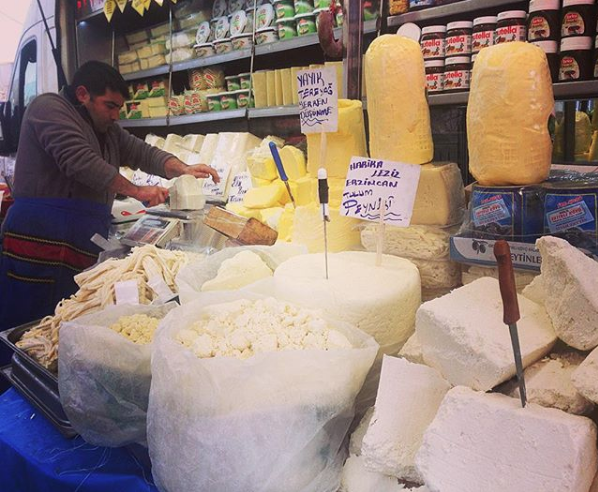
If you have ever been to a weekly pazar (market) in Istanbul, you’ll know it is nothing like the neat-aisled Migros or Şok markets on the corner of your street. Pazars have an authentic feel with their sheet-covered streets, which turn the markets into a kind of sanctuary of fresh food. The hectic shouting of vendors to passersby, children running between stalls, and colorful piles of produce and goods in every direction will leave you mesmerized. I love listening to the calls of the stall keepers “Bir lira! Domates! Kilosu üç lira!” And if you’re lucky, you will hear old men singing Anatolian songs as you hand over your Lira.

Going to the bazaar is the highlight of my Tuesdays.

The smell of fresh produce always puts me in good spirits as I stroll through the long winding street in Emirgan. The best time to go is in the morning when the sun is shining and you’ll have the best choice of vegetables and fruit. Before purchasing anything, I first walk the entire pazar to get a look at the prices as they change every week.  Men and young boys generally work the stalls, but I’ve also seen women filling the plastic buckets with pomegranates and apples. Everything is priced per kilo and I am still surprised every week at how cheap the prices are. You’ll leave the pazar with heavy bags and full pockets. Make sure to bring cash though as your MasterCard is useless here.

Don't miss your chance to experience a local bazaar! Emirgan Bazaar, Sarıyer
Emirgan pazar, Sarıyer

Turks prefer to buy produce that is both seasonal and regional to Turkey. Most of the produce is picked weekly and I can taste the difference between my pazar bananas and those purchased in the supermarket. It’s okay to try free samples throughout the market and you’ll see Turks tasting grapes, cheese, nuts, olives, mandarins, and everything in between. My favorite stalls have giant barrels of olives lining the front and I practice my Turkish conversation skills as I’m offered countless delicious samples.

If you are like me and in the process of learning Turkish, the pazar is a fantastic place to practice. The vendor’s English is limited and some unscrupulous types try to cheat customers if they know you are foreign (always count your change!). It’s best to try and avoid speaking English when paying and try your hand at Turkish instead.

Common Turkish Market Phrases:

  • Kaç Lira?   –  What is the price?How much?
  • Kilosu ne kadar?  –  How much for a kilo?
  • Bir/Iki/Üç kilo.  –  One/two/three kilos.
  • Bunlardan alabilir miyim?  –   May I have some of those?
  • Iyi günler!  – Good day! (Hello and Goodbye)
  • Teşekkürler!  –  Thank you!
Located under a triangular modern dome, the Beşiktaş Fish Market runs everyday. Photo credit: Suheda Aykut
Located under a triangular modern dome, the Beşiktaş Fish Market runs everyday.  Photo credit: Suheda Aykut

Most major pazars in Istanbul operate one day a week and the locals flock from surrounding neighborhoods for the best prices and freshest picks. If you are staying near Taksim, Tarlabaşı Sunday Bazaar is worth visiting. On the Asian side, the Kadıköy market on Tuesday’s boasts the freshest fish in all of İstanbul. And in the old city, Fatih has a huge marke every Wednesday. You can find food pazars in most major neighborhoods in İstanbul.

Once I get my groceries home, my day of cooking begins. Women do most of the cooking in Turkish culture, but that shouldn’t stop you men! A culture shift is occurring with the younger generation of Turkish men knowing their way around the kitchen. Cooking authentic, Turkish food at home is easy, delicious, and a big part of their culture. Turks don’t understand the Western culture of buying processed or frozen food. So, I was determined to learn some recipes, and (top tip alert!) they all begin with a good quality bottle of oil.

Cacık is a refreshing yogurt-based dish. The cold soup is made of yogurt, water, cucumbers, dill, olive oil, and salt. Photo credit: Kişniş Otu

Two of my favorite Turkish recipes are Cacık and zeytinyağlı kereviz. I take advantage of these recipes as you won’t find thick Turkish yogurt and celeriac everywhere else. Both recipes are for beginner cooks and you’ll have great dishes in a short time. When Turks cook they often make more food than necessary and bring extras to thei neighbors. The sharing culture extends even into simple meals in Turkey.

Living with a Turkish family recently I have come to appreciate mealtimes, which are as much a social event as a daily necessity.

We can sit and chat for hours over a meze-style dinner, sharing lots of little plates. I have begun to recognize the odd quirks at the dinner table, like saying Afiyet Olsun (Bon Appetite) before and after a meal! Turks love to know that your stomach is happy at the end of the night, so I make sure to thank my Turkish host mother several times. With gracious company and a relaxed dinner atmosphere, you’ll soon be dining like a true Turk!

Original posting on Istanbul Tour Studios.

Why Bucknell Women Should Listen to More Rap

Rap is genre largely ignored by the female population on Bucknell University’s campus and is seen as the boy’s club of the music industry. The historically aggressive and dark themes surrounding rap culture has turned off most young women, who are in favor of popular top hits that are sing-able and light-hearted. The negative connotations associated with rap do not help the genre either, especially perpetuated gender roles for both men and women. Messages of poverty, violence, and gang life are not relatable for your average female Bucknell student. In addition, the over sexualizing of the female body is another reason most women shy away from the “crude” genre. So, why should women at Bucknell consider listening to rap?

Rap is constantly changing just like any other music category. Growing up and going through high school, I avoided rap like the plague. I hated rap and did not understand the genre. Why would anyone want to listen to songs they couldn’t sing along to? Most women Bucknellians knowledge on rap ends with Eminem, Jay Z, and Drake (if you even know these rappers). This was also my understanding of rap coming into freshmen year. Being exposed to new people on campus and new music, I quickly started listening to Wiz Khalifa, J. Cole, and Kid Cudi.

Soundtrack 2 My Life by Kid Cudi

The beat and feel of these artists offer a great introduction to the world of rap. Needless to say, my relationship with rap began to change as I broadened my tastes over the next three years. Some of my favorite rap albums include Illmatic (Nas), Section 80 (Kendrick Lamar), My Beautiful Dark Desire (Kayne West) and When Life gives you Lemons, You Paint that Shit Gold (Atmosphere). I highly recommend listening to an entire rap album all at once because it is an experience. Until recently, I did not realize why I have come to love the genre. 

I’ll admit it isn’t party music, but rap offers something truly unique. Every song is a new perspective with an interesting story. If you listen to the lyrics, most songs tell a unique story. Atmosphere is particularly good at changing perspectives in each song and is my favorite rap artist. The best rap albums create a story that is told throughout the entire album. This is one reason Eminem dominated the rap industry in the early 2000s, not to mention he is a lyrical genius. So much so that my brother dubbed him the “modern-day Shakespeare.” His wordplay and flow can be thought of as poetic, and if we compare rap to poetry, than rappers can be seen as poets. 

Infinite by Eminem

Today, rap artists are changing the industry by being more open about gender roles, social issues, and defining happiness and success in modern society. Rappers like Macklemore have addressed LBGT issues and Lupe Fiasco who has addressed adolescence and becoming a young adult in a challenging world. Modern rappers have continued to challenge modern rap society and stereotypes associated with the industry. The increasing number of women rappers – such as Nicki Minaji and Iggy Izalea  – have also brought new listeners to the genre.

When I listen to rap it is independent of others so that I can focus on the lyrics. It is great to throw on while studying or as background music. Rap to me represents another form of poetry and storytelling simply combined with melody and rhythm. Women should listen to rap because it offers new perspectives and views outside of the Bucknell “bubble life”. You may be surprised at how relatable some of their stories are. 

The Waitress by Atmosphere

My Rap Playlist:

  1. The World Might Not Live through the Night (Atmosphere)
  2. Get Down (Nas)
  3. Money Trees (Kendrick Lamar)
  4. Kool Aid and Frozen Pizza (Mac Miller)
  5. Acid Raindrops (People Under the Stairs)
  6. The Best Day (Atmosphere)
  7. Gorgeous (Kayne West)
  8. Infinite (Eminem)
  9. Check the Rhyme (Tribe Called Quest)
  10. Lost Ones (J Cole)
  11. The Writer (Chance the Rapper)
  12. Pills N Potions (Nicki Minaja)
  13. The Waitress (Atmosphere)
  14. Coming Up (Lupe Fiasco)
  15. Jimmy Recard (Drapht)
Original posting in Bucknell University’s Campus Vinyl, February 2015.